



Ask an expert: how do I manage yeast stressors in ethanol fermentation?

During ethanol fermentation, yeast cells encounter continuously changing environmental conditions. The yeast responds to these changes by adapting its metabolism—a crucial process to protect the cell and ensure its survival. But this physiological and metabolic response has a ripple effect on fermentation, which can lead to reduced growth rates, viability and cell counts, as well as an impact on morphology, such as cell shape, size and appearance. It can also cause stuck or sluggish fermentations from decreased substrate utilization, decreased titers and production rates, and increased by-product formation.
To ensure maximum ethanol yields, it’s important to understand common yeast stressors and how to identify them. Here, we ask our fermentation expert Lee Robinson, Global Sr. Field Application Scientist, IFF, everything you need to know about yeast stressors.
What affects yeast during fermentation?
There are a variety of factors that affect yeast health, both in propagation and fermentation. Some of the common stress factors and their inhibitory levels include: Temperature (35-38°C). For our top tips to manage high temperature fermentation, read our blog here
- pH (>3.5)
- Ethanol stress (12% w/v)
- And many more factors, including sodium levels and osmotic pressure.
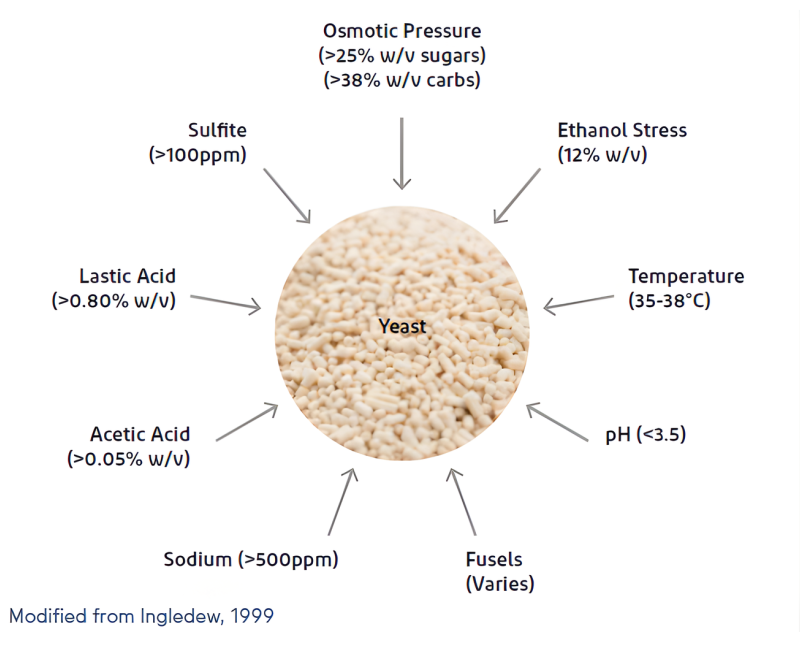
The challenge is that there is rarely only one source of stress present during propagation and fermentation. Conditions that are normally below inhibitory levels can induce stress in yeast in the presence of other factors/inhibitors, which is known as synergistic effects.
How can I reduce yeast stressors?
So-called ‘bad’ fermentations can have costly consequences in ethanol plants. Choosing the right yeast strains is key – the more robust, the better. This helps reduce the impact of stress on overall fermentation performance. More generally, yeast also needs adequate nutrition and optimal growth conditions to thrive and mitigate the effects of stress. For a deep dive on yeast nutrient requirements and additional insights on growth, click here
How do I identify stressed yeast?
Monitoring fermentation for signs of yeast stress can be done in several ways. During propagation, a reduced yeast cell count is one indication that it is stressed, as well as low viability at around 60-70%. Another general sign of stressed yeast is high glucose levels, which can be a result of slow substrate utilization.
Ethanol fermentation is a complex process. Monitoring and controlling yeast stress is essential for ensuring optimal yields and production efficiency. With a better understanding of yeast stressors, we can mitigate operational issues earlier on and reduce the overall impact. For more information on the yeast stressor signals to spot, download our bitesize guide today.
Meet the author:
Lee is a Global Senior Field Application Scientist at the Applied Innovation Center in Cedar Rapids, Iowa, USA. He has been a part of the IFF team for the past 7 years but prior to joining IFF he worked for various start-ups focused on developing yeasts for production of fuels and specialty chemicals. In his current position he is focused on developing new yeast and enzyme applications for the grain processing market. Lee holds a Master’s degree in Microbial Engineering from the University of Minnesota.