




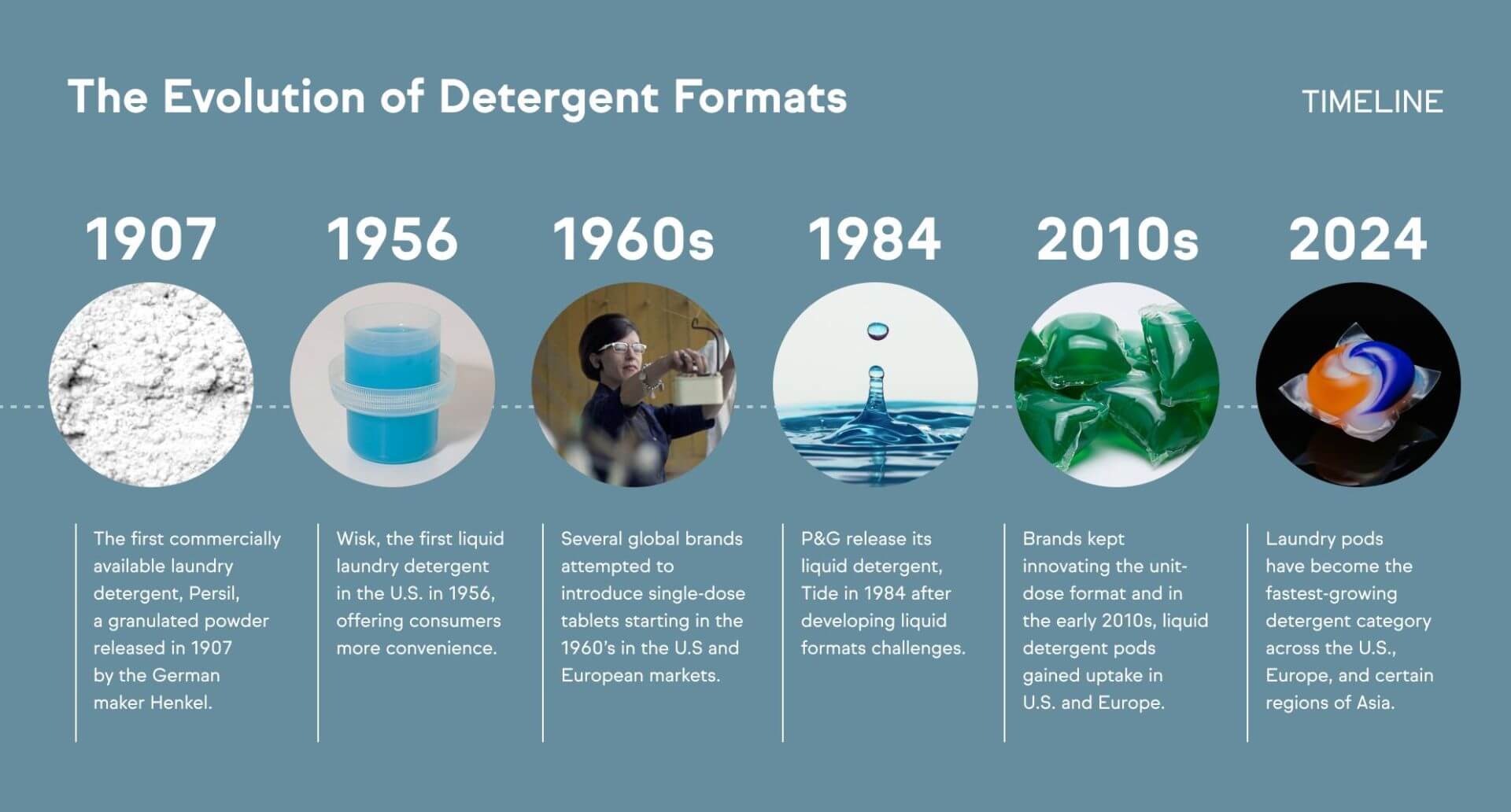
The Evolution of Detergent Formats
| The first commercially available laundry detergent, Persil, a granulated powder released in 1907 by the German maker Henkel, was considered a scientific breakthrough and a major improvement over the laundry soap bars used at the time, which left a scum residue on clothing washed in hard water.
Fast forward a few decades and liquid detergents emerged, providing consumers with greater convenience through easier measuring, dissolving, and pre-treatment options. However, developing liquid formats proved to be much more chemically complex than granules, a challenge that continues today. Formulators must ensure that all the active ingredients, from surfactants to enzymes, remain stable throughout the life cycle of the detergent. For this reason, P&G didn’t release its liquid version of Tide until 1984. |
Next came the introduction of unit dose detergents (pods or tablets) offering even more convenience for consumers with their pre-measured doses and portability. Though this format didn’t achieve instant success. Several global brands attempted to introduce single-dose tablets starting in the 1960’s in the U.S and European markets. These early failures showed that offering convenience was not enough; unit doses needed to match or exceed the performance of existing formats, all while delivering value to customers.
Brands kept innovating the unit-dose format and in the early 2010s, liquid detergent pods gained uptake in the U.S. and Europe. Today, laundry pods have become the fastest-growing detergent category across the U.S., Europe, and certain regions of Asia. |
The Laundry Lens
As we’ve seen with the journey of unit doses, simply introducing an innovative new format doesn’t guarantee instant success. More often, consumers gradually embrace new formats over time. For detergent makers, when launching any new innovations, it’s important to consider the timing of the product release and the context of your regional market.
“The success of a new detergent format goes beyond your innovation
How you promote the product and the claims you put behind it will also determine whether it ultimately sticks with consumers,”
says Tatiana Goncharova,
Global Business Segment Leader at IFF.

By the numbers


China’s Swift Shift
Contrary to the global trend of slow acceptance, Chinese consumers have swiftly adopted newer, more convenient detergent formats for their laundry routines. This rapid uptake is driven by China’s booming economy over the past decade, leading to an expanding middle class that readily welcomes these innovative formats.
China’s detergent format revolution
75% average annual growth in unit dose usage since 2018
Laundry Lens
The successful launch of unit doses in China shows the importance of understanding local consumer habits and preferences when unveiling new products. Detergent makers were recently reminded of this, following an unsuccessful attempt to introduce high-concentrated liquid formulas to the market. These were seen as offering less value with their smaller packaging size.
“The unit dose is successful because it offers clear consumer benefits:
convenience with smaller packaging and multi-functionality,”
says Lynn Meng,
Asia Pacific Business Segment Lead at IFF based in Shanghai.
Some Chinese detergent pods include up to seven chambers each claiming to offer a different benefit. These pods also have consumer-appealing designs in various colors and shapes, such as flowers or animals. Despite the novel designs, Chinese laundry pods are not considered a super-premium product and can be produced at lower costs than in Europe and North America.
Source: Nice
Source: Liby
Source: Watson private label
A big part of the success story of unit doses in China is tied to the country’s booming e-commerce market, where consumers make virtually all their household purchases online. Chinese detergent brands have relied heavily on influencers on social platforms such as Little Red Book and Douyin (Tik Tok) to introduce unit doses directly to consumers. This social sales approach has made the information more trustworthy, says Meng, as it comes from individuals sharing their experiences.
“For big brands outside of China, there might be learnings
in how they can move more towards a sales pitch on these channels versus just a corporate branding pitch,”
says Annemarieke van Heeswijk,
Marketing and Communications Lead at IFF.
3 trends to watch in unit doses
The Debut of Game-changing Formats: Water-less Detergents
While laundry sheets failed to take off in China many years ago, new versions of this liquid-less format are emerging in the U.S. and E.U., designed to meet the rising consumer demand for more sustainable and convenient detergent options. Leading the pack, Procter & Gamble recently launched Tide Evo, a multi-layered detergent square for U.S. markets.
These waterless products generally use recyclable cardboard packaging, eliminating the need for plastic detergents bottles, and offer a compact, easy-to-use solution for laundry. But despite their innovative design and eco-friendly appeal, it’s important to consider the product’s overall environmental impact and performance.
Laundry sheets are produced using an energy-intensive heat process that can reach up to 90 degrees Celsius. This method can impact the stability of the enzymes and other ingredients used in these products. Furthermore, most of these products are produced by original equipment manufacturers (OEMs) in China for export, adding another layer to their sustainability footprint.
The Laundry Lens
To better understand the performance of laundry sheets, our applications team recently conducted an internal benchmarking study on several versions currently available on the market. Despite many of these brands listing enzymes (protease) as ingredients, the study found that these sheets did not clean as effectively as liquid detergents, especially when it came to enzymatic stains. This is likely due to the large difference in dosing between sheets and liquid formats.
“The detergent dose in sheets is about ten times less than in a standard HDL
resulting in poorer cleaning performance which we found in our internal tests,”
says Grace Lau,
Senior Application Specialist, IFF Palo Alto, who led the study.
However, this performance gap highlights an opportunity for innovation. The shift towards liquid-less formats is a great leap for the industry. And history has taught us with unit doses that innovative formats often initially stumble due to a mix of factors, such as performance issues or lack of market readiness.
Today’s laundry brands must persist in refining and innovating these waterless products. Numerous brands, ranging from boutique to multinationals, are working on these formats and ultimately it will be the big players to drive mass consumer acceptance.


Importance of partnership
At IFF, we’re continually innovating our enzymes for detergent formulas to be more stable and enhance cold-water washing. We work closely with our customers on developing powerful enzymes suitable for multiple formats to high-efficiency laundry detergents (HDLs) to unit doses.
Continuous Innovation
As detergent formats continue to evolve in response to consumer needs, technological advances and regulatory changes, detergent brands are faced with some key challenges. It’s not just about meeting these evolving demands, but surpassing them by setting new standards for convenience, performance, and sustainability. This evolution calls continuous innovation, collaboration, and a strategic approach to shape the future of detergent formats.

Explore more Clean Insights